Sunnyvale's Eichler Design Guidelines Aren't Zoning. One Fairbrae Case Proved It.
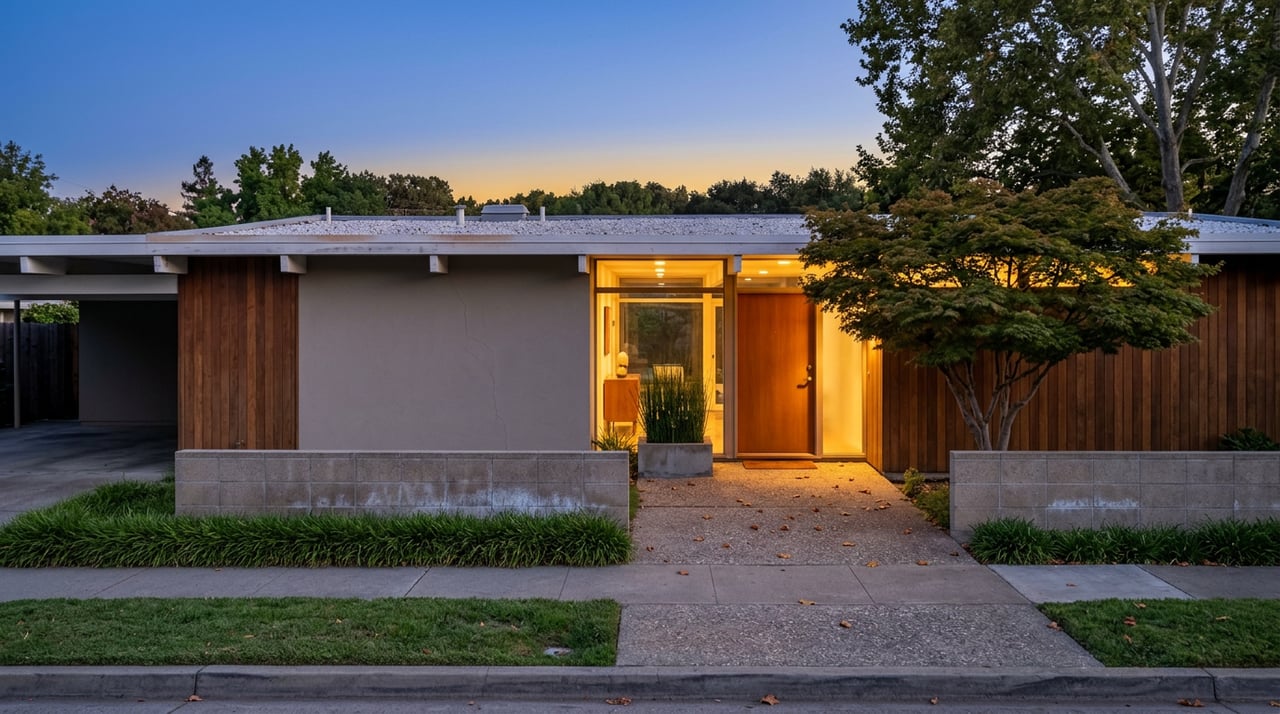
In 2016, a homeowner named Vitaly Eliashberg filed plans for a new 3,600-square-foot house on Sesame Drive, in the heart of Sunnyvale's Fairbrae tract. Neighbors appealed. Their argument was straightforward: the house was too big, too modern in the wrong way, and out of step with a neighborhood built almost entirely of low, glass-walled Eichlers from the late 1950s. The Sunnyvale Planning Commission heard the appeal, reviewed the city's own Eichler Design Guidelines, and approved the house anyway. The plans met every zoning requirement. The guidelines had nothing in them that could stop a compliant project from getting built.
That outcome matters to anyone shopping Sunnyvale's Eichler tracts today, because the premium buyers pay for these homes rests partly on an assumption the Sesame Drive case quietly disproved: that the city's design guidelines function like a homeowners association, locking a tract's character in place. They don't. They're advisory. And the gap between what people think they're buying and what the guidelines actually deliver is the kind of thing that only shows up once you're deep in a transaction, not while you're scrolling listing photos.
Sunnyvale adopted its Eichler Design Guidelines in 2009, and they still apply today to a specific list of tracts: Fairbrae, Fairwood, Rancho Verde, Fairorchard, Primewood, Parmer Place, Midtown, Rancho Sans Souci, and their additions. The stated purpose is to help new construction and remodels "preserve the unique character of Eichler homes and their neighborhood." That's a real city program, published on the city's planning site, not marketing language from a real estate team.
What it isn't is enforceable in the way a deed restriction or an HOA covenant is enforceable. A Sunnyvale planning commissioner made this explicit during the Sesame Drive hearing, noting on the record that the guidelines apply to design but carry none of the force of a zoning ordinance. The same hearing produced a detail worth knowing on its own: one commissioner pointed out that a new home literally cannot replicate a classic Eichler today, because a flat-roofed, single-pane-glass structure from 1960 would not clear current energy code. Every Eichler standing in Sunnyvale is, in that narrow sense, something the market can no longer manufacture. That scarcity is real. The guidelines protecting it are softer than most buyers assume.
In the years after the Sesame Drive decision, some Fairbrae residents began pursuing something with actual zoning teeth: a single-story combining district, which restricts building height by ordinance rather than by suggestion. That process is tract-specific and not something every Eichler neighborhood in Sunnyvale has pursued or completed. If you're evaluating a home in one of these tracts, the design guidelines are not the question to ask. Whether that specific tract has a single-story overlay on file with the city is.
Sunnyvale is where Joseph Eichler started building, even though Palo Alto now counts more Eichler homes overall. Roughly 1,100 of them stand across Sunnyvale today, spread over a set of named tracts that each carry their own history and, increasingly, their own pricing logic.
| Tract | Built | Approx. homes | What sets it apart |
|---|---|---|---|
| Fairbrae | 1958-1961 | ~78 original, plus ~275 in the Fairbrae Addition | Anchored by the private Fairbrae Swim & Racquet Club, built alongside the housing |
| Fairwood | 1961-1962 | 215 | Slightly larger floor plans than Fairbrae's original run |
| Rancho Verde / Rancho Verde Addition | 1960-1962 | 140, plus a 40-home Addition | Adjoins Fairbrae; introduced architect Claude Oakland's Gallery model |
| Fairorchard | 1958 | 54 | Steve Wozniak grew up here on Edmonton Avenue; the tract falls inside the Cupertino school district despite its Sunnyvale address |
| Parmer Place | 1967 | 42 | Built after Eichler's company emerged from a mid-1960s bankruptcy, in a more semi-custom era |
| Midtown | 1969 | 15 | Sunnyvale's smallest Eichler tract; homes here rarely change hands |
That last row is worth sitting with. A 15-home tract doesn't generate enough sales in a given year to produce a meaningful median of its own. Any citywide number that includes Midtown, Fairbrae, and a 1970s tract-home subdivision on the same spreadsheet is averaging things that don't behave alike, and that's before you get to the roughly two-thirds of Sunnyvale that isn't Eichler stock at all.
Ask three sources what a Sunnyvale home costs right now and you'll get three different answers, and the gap isn't a rounding error. As of late July 2026, one major home-value index put Sunnyvale's average home value at just over $2.05 million, up less than one percent from a year earlier. Over the three months ending in June 2026, a separate tracker of actual closed sales put the median sale price at $1.8 million, down more than 17 percent year over year. A third source tracking active listings in September 2026 put the median asking price closer to $1.48 million.
None of those numbers is wrong. They're measuring different things. One is an index built to control for what's actually selling. One is a raw median of closed transactions in a specific three-month window. One is what sellers are asking for homes not yet under contract. When the mix of what closes shifts, quickly, toward more condos and starter homes and away from luxury single-family sales, a raw median can fall even while the value of any individual home barely moves. That same June 2026 data point that showed the 17 percent decline also showed 302 homes sold that month, up from 262 a year earlier. More transactions, a lower reported median. That's a mix shift, not a market that lost a fifth of its value in a year.
For an Eichler buyer, the practical takeaway is to stop asking what Sunnyvale homes cost and start asking what homes in that specific tract, in that specific condition, have actually closed for recently. A citywide median tells you almost nothing about what a well-preserved Fairbrae atrium model or a Fairwood original is trading for this quarter, because those sales are a small, specific slice of a much larger and more varied pool.
Three things worth confirming before you write an offer in a Sunnyvale Eichler tract. First, ask whether that specific tract, not Sunnyvale generally, has adopted a single-story combining district. If it hasn't, the design guidelines alone won't stop a neighbor from building something out of scale, and that's a fact worth knowing before you fall in love with the quiet street. Second, treat inspection differently than you would for a standard 1970s ranch. Flat and low-slope roofs, embedded radiant slab heating, and original single-pane glass all call for a contractor who has actually worked on Eichler systems before, not a generalist. Third, pull comps from the tract itself. A Fairbrae sale and a Primewood sale are not interchangeable data points even though both are technically Eichlers in the same city.
None of this makes these homes a bad buy. It makes them a specific one, with a specific set of questions that a citywide market report was never built to answer.
Do all of Sunnyvale's roughly 1,100 Eichler homes fall under the design guidelines? No. The guidelines apply to the named tracts on the city's list, including Fairbrae, Fairwood, Rancho Verde, Fairorchard, Primewood, Parmer Place, Midtown, and Rancho Sans Souci. A handful of smaller, scattered Eichler clusters elsewhere in the city may not be covered the same way, so it's worth confirming tract by tract.
Can I build a two-story addition on an Eichler in one of these tracts? The design guidelines don't prohibit it outright. Whether it's realistic depends on whether that specific tract has a single-story combining district in place, which does carry zoning force. That status varies by tract and is worth checking with the city before you assume either way.
Does the Eichler premium apply evenly across all these tracts? No. Condition, lot size, tract identity, and how much of the original design survives all move the number independently. A well-preserved Fairbrae home and a heavily altered Eichler in a smaller tract are not priced off the same curve, even within the same city.
If you're weighing a Sunnyvale Eichler against a more conventional home elsewhere in Santa Clara County, or trying to figure out what a specific tract is actually commanding right now, that's a conversation worth having before you're mid-offer. You can look through more of Sunnyvale's neighborhoods and current listings or reach out directly to Janet Souza to schedule a chat about what a specific address, tract, and timeline actually look like.
Hello! I'm Janet Souza, lifestyle blogger and REALTOR® at Christie's International Real Estate Sereno. I live and work in Silicon Valley and love everything our wonderful area has to offer. If you live in Silicon Valley or are thinking about moving here, you've come to the right place! Stay up to date with local events, theater, concerts, Real Estate and more!


Fundamental to how Janet Souza views her role as her client’s real estate advisor, she seamlessly blends her former professional worlds that span consulting, engineering, marketing, strategy, and executive sales negotiations as her frame of reference, bringing a premier standard of performance and uncompromised integrity to her clients.